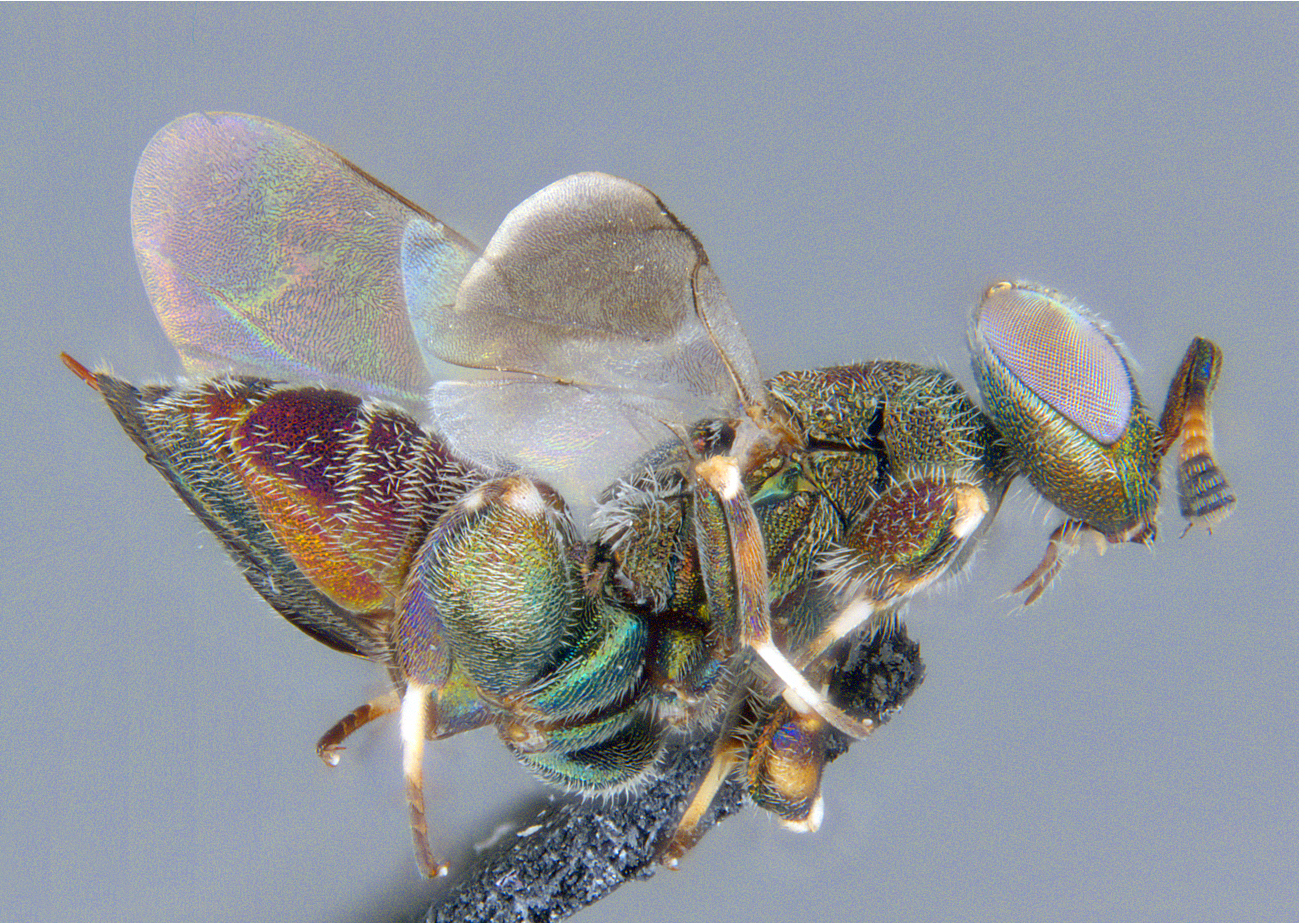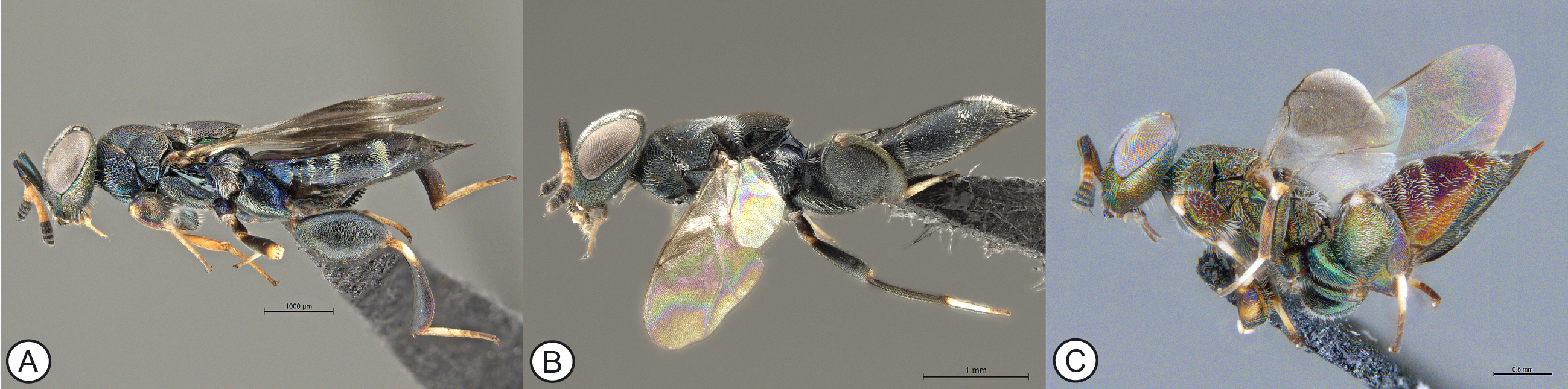
1 Female (A, B, C) …2
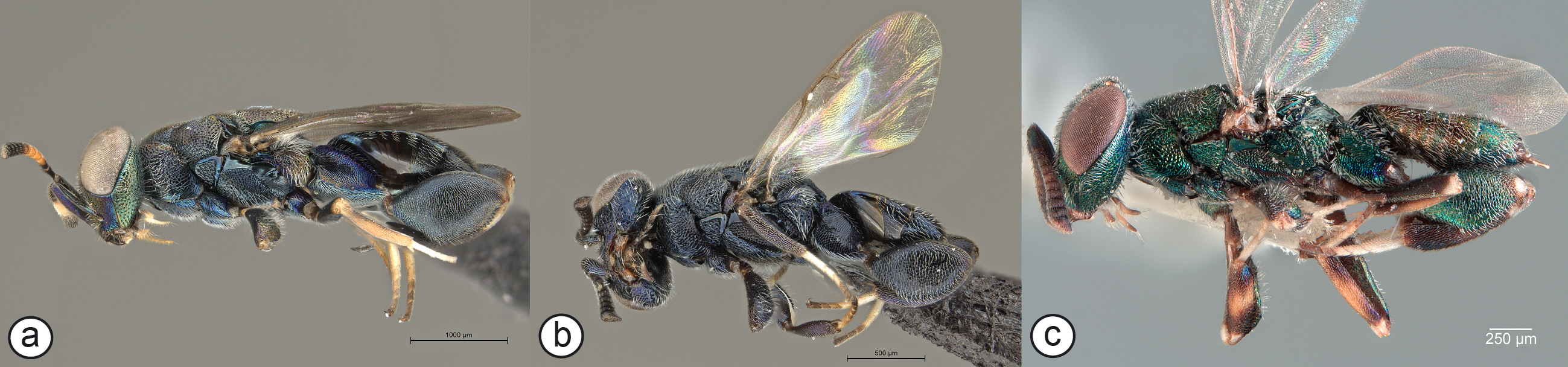 - Male (a, b, c) …7 - Male (a, b, c) …7
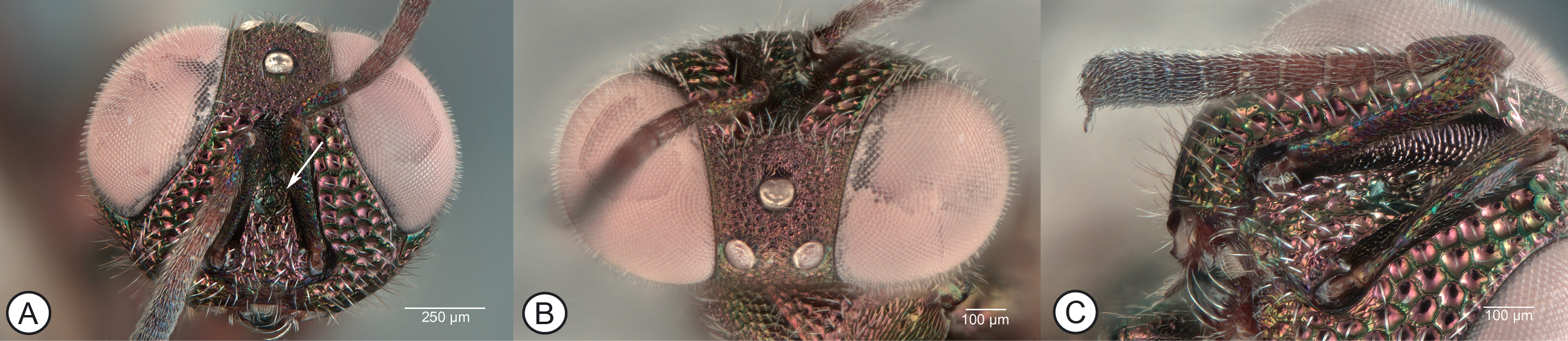
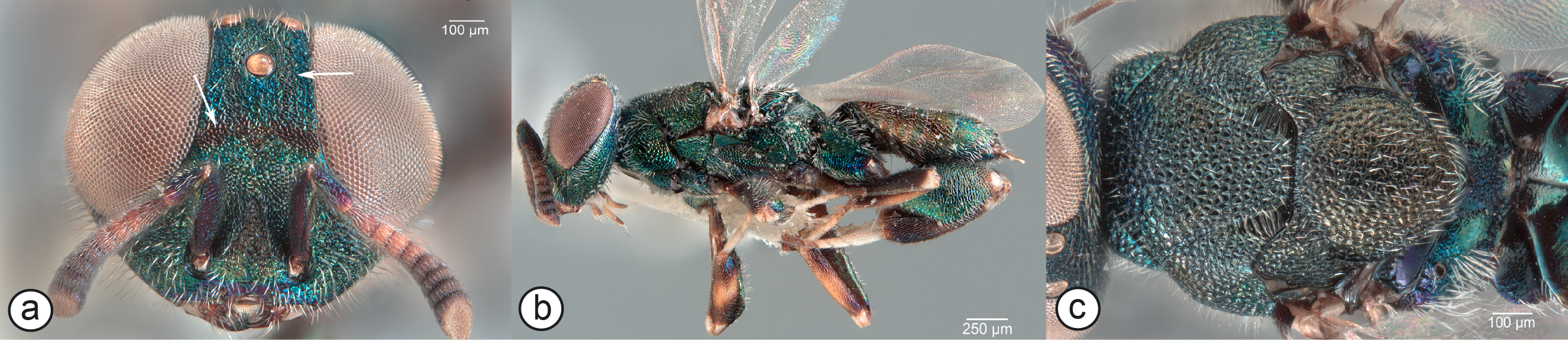
2(1) Head with frontovertex punctate-rugulose, but parascrobal region and lower face lateral of clypeus much more coarsely punctate-umbilicate (A, B, C); interantennal region dorsally concave, hence with ꓴ-shaped dorsal margin (A: arrow) …Chalcedectus bisculpturatus Gibson, 2026.
 - Head with frontovertex, parascrobal region and lower face lateral of clypeus all similarly finely (a) or coarsely sculptured (b, c); interantennal region uniformly convex and dorsally angulate (ꓥ-shaped) (a, b, c) …3 - Head with frontovertex, parascrobal region and lower face lateral of clypeus all similarly finely (a) or coarsely sculptured (b, c); interantennal region uniformly convex and dorsally angulate (ꓥ-shaped) (a, b, c) …3
 3(2) Mesoscutal medial lobe with adnotaular region smooth to finely sculptured but not carinate (A); legs almost always with pro- and mesotibiae extensively yellowish apically (B) and metatibia often also with subbasal pale spot (B) to longer pale region along part or entire dorsal margin; fore wing disc variably distinctly infuscate with dark setae except with subapical hyaline cross band with white setae beyond level of stigmal vein (B, C) (Fig. 17E); labial and maxillary palps yellow and maxillary palp with apical segment obviously elongate, about ¾ length of scape (D) ...Chalcedectus schroderae van Noort, 2026. 3(2) Mesoscutal medial lobe with adnotaular region smooth to finely sculptured but not carinate (A); legs almost always with pro- and mesotibiae extensively yellowish apically (B) and metatibia often also with subbasal pale spot (B) to longer pale region along part or entire dorsal margin; fore wing disc variably distinctly infuscate with dark setae except with subapical hyaline cross band with white setae beyond level of stigmal vein (B, C) (Fig. 17E); labial and maxillary palps yellow and maxillary palp with apical segment obviously elongate, about ¾ length of scape (D) ...Chalcedectus schroderae van Noort, 2026.
 - Mesoscutal medial lobe with adnotaular region obliquely carinate (a); legs with pro- and mesotibia often dark (b) or medially pale-banded (c) or at most orangey-brown apically, but not extensively yellowish; fore wing variable in colour pattern (b, c), but without subapical hyaline band (b, c); labial and maxillary palps sometimes dark and comparatively shorter (b, c) …4 - Mesoscutal medial lobe with adnotaular region obliquely carinate (a); legs with pro- and mesotibia often dark (b) or medially pale-banded (c) or at most orangey-brown apically, but not extensively yellowish; fore wing variable in colour pattern (b, c), but without subapical hyaline band (b, c); labial and maxillary palps sometimes dark and comparatively shorter (b, c) …4
 4(3) Legs with knees pale (femora apically, and tibiae basally or subapically, white) (A, B); tibiae sometimes banded, pale medially (A, B) …5 4(3) Legs with knees pale (femora apically, and tibiae basally or subapically, white) (A, B); tibiae sometimes banded, pale medially (A, B) …5
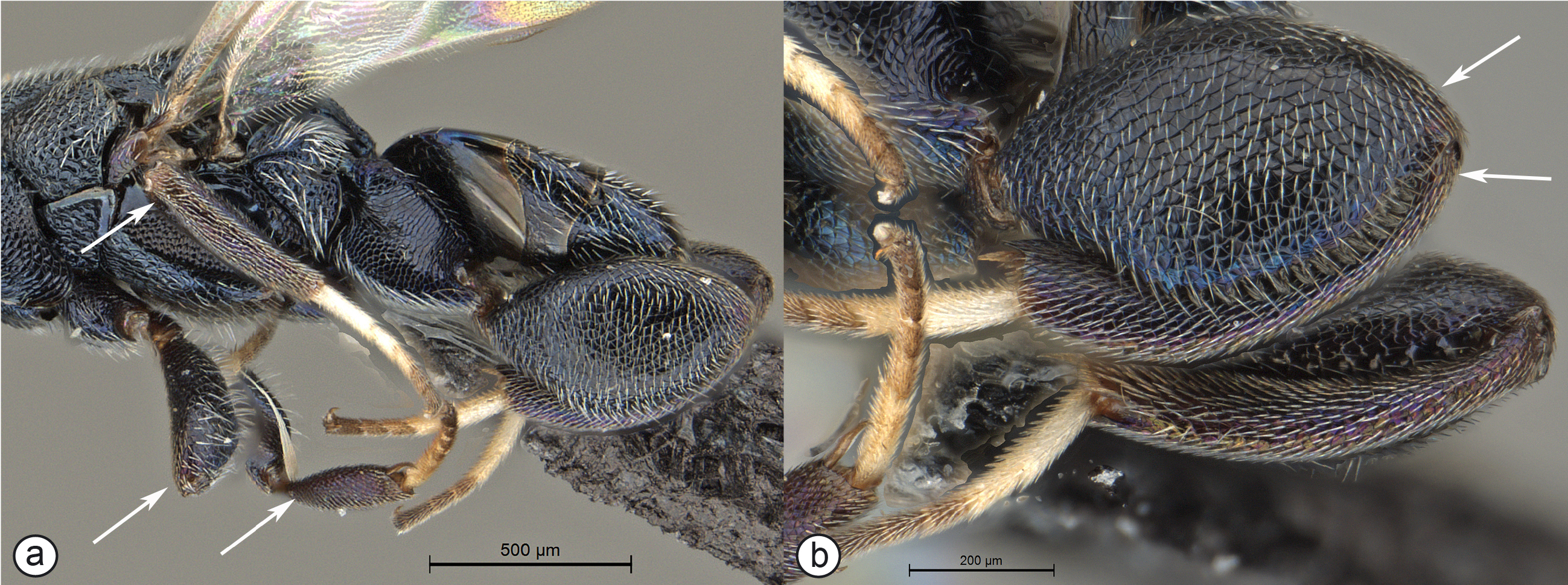 - Legs with knees dark (femora apically and tibiae basally similarly dark) (a, b); tibiae entirely dark (a, b) or one or more variably extensively orangey-brown apically …6 - Legs with knees dark (femora apically and tibiae basally similarly dark) (a, b); tibiae entirely dark (a, b) or one or more variably extensively orangey-brown apically …6
 5(4) Legs with tibiae or at least pro- and mesotibiae variably conspicuously banded (dark-pale-dark) beyond basal white spot (A); gaster with one or two tergites anterior of penultimate, spiracle-bearing tergite strongly sculptured, mesh like reticulate to punctate (B); fore wing hyaline to variably conspicuously infuscate with dark setae except usually hyaline with white setae along apical margin (C) …Chalcedectus tankwa van Noort & Mitroiu, 2026. 5(4) Legs with tibiae or at least pro- and mesotibiae variably conspicuously banded (dark-pale-dark) beyond basal white spot (A); gaster with one or two tergites anterior of penultimate, spiracle-bearing tergite strongly sculptured, mesh like reticulate to punctate (B); fore wing hyaline to variably conspicuously infuscate with dark setae except usually hyaline with white setae along apical margin (C) …Chalcedectus tankwa van Noort & Mitroiu, 2026.
 - Legs with tibiae dark beyond basal white spot or at most somewhat paler apically but not medially banded (a); gaster with all terga anterior of penultimate, spiracle-bearing tergite finely sculptured, mesh like coriaceous to transversely coriaceous-alutaceous (b); fore wing hyaline with dark setae extending to apical margin except disc with at least some white setae behind submarginal vein beyond basal cell and mesally below level of stigmal vein (c) …Chalcedectus madagascarensis Gibson, 2026. - Legs with tibiae dark beyond basal white spot or at most somewhat paler apically but not medially banded (a); gaster with all terga anterior of penultimate, spiracle-bearing tergite finely sculptured, mesh like coriaceous to transversely coriaceous-alutaceous (b); fore wing hyaline with dark setae extending to apical margin except disc with at least some white setae behind submarginal vein beyond basal cell and mesally below level of stigmal vein (c) …Chalcedectus madagascarensis Gibson, 2026.
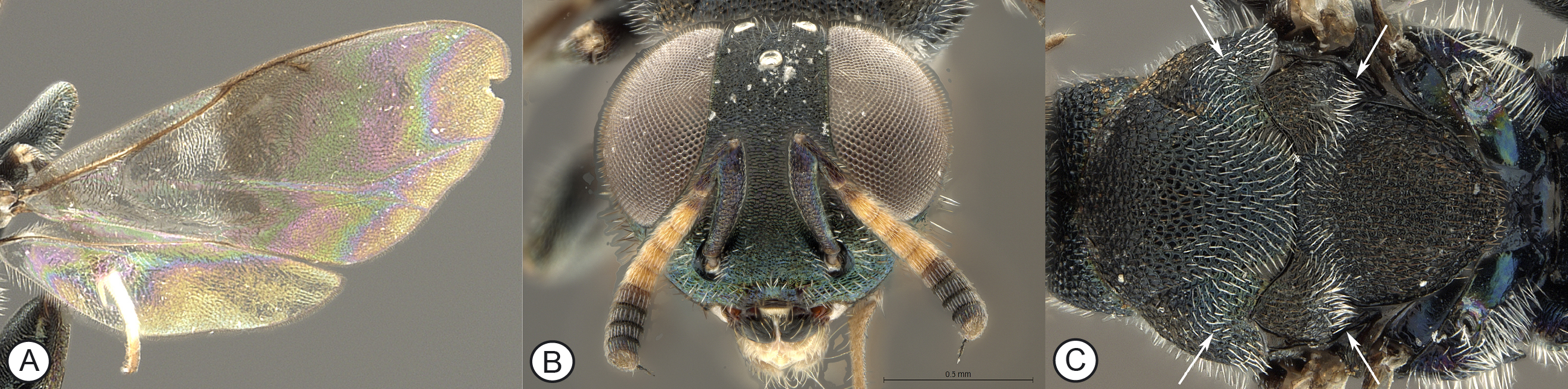 6(4) Fore wing infuscate with dark setae behind marginal and stigmal veins and behind most of submarginal vein, but with band of white setae behind submarginal vein apically that is divided medially by dark setae on medial fold extending to disc (A); head black with metallic green lustre ventrally and weak setae (B); mesosoma with two transverse bands of white setae, meeting medially, with setae on anterior mesoscutum, anterior axillae and mesoscutellum brown (C) …Chalcedectus mabeabai van Noort, 2026. 6(4) Fore wing infuscate with dark setae behind marginal and stigmal veins and behind most of submarginal vein, but with band of white setae behind submarginal vein apically that is divided medially by dark setae on medial fold extending to disc (A); head black with metallic green lustre ventrally and weak setae (B); mesosoma with two transverse bands of white setae, meeting medially, with setae on anterior mesoscutum, anterior axillae and mesoscutellum brown (C) …Chalcedectus mabeabai van Noort, 2026.
 - Fore wing hyaline to variably distinctly infuscate behind marginal and sometimes stigmal veins but at least hyaline behind submarginal vein and if with dark setae within basal cell then these not extending mediolongitudinally to disc (a, b); head metallic blue-black with stout white setae (c); mesosoma more or less evenly covered with white setae (d) …Chalcedectus copelandi Gibson & van Noort, 2026. - Fore wing hyaline to variably distinctly infuscate behind marginal and sometimes stigmal veins but at least hyaline behind submarginal vein and if with dark setae within basal cell then these not extending mediolongitudinally to disc (a, b); head metallic blue-black with stout white setae (c); mesosoma more or less evenly covered with white setae (d) …Chalcedectus copelandi Gibson & van Noort, 2026.
 7(1) Mesoscutal medial lobe with adnotaular region smooth to finely sculptured but not carinate (A); frontovertex micropunctate with separate, circular, pin prick-like punctures separated by microcoriaceous interstices (B); labial and maxillary palps yellow and maxillary palp with apical segment obviously elongate, at least ¾ length of scape (C); metatibia with basal or subbasal white region (C) and pro- and mesotibiae usually extensively yellowish apically (C) …Chalcedectus schroderae van Noort, 2026. 7(1) Mesoscutal medial lobe with adnotaular region smooth to finely sculptured but not carinate (A); frontovertex micropunctate with separate, circular, pin prick-like punctures separated by microcoriaceous interstices (B); labial and maxillary palps yellow and maxillary palp with apical segment obviously elongate, at least ¾ length of scape (C); metatibia with basal or subbasal white region (C) and pro- and mesotibiae usually extensively yellowish apically (C) …Chalcedectus schroderae van Noort, 2026.
 - Mesoscutal medial lobe with adnotaular region obliquely carinate (a); frontovertex punctate-rugulose (b); labial and maxillary palps often dark and maxillary palp with apical segment not so conspicuously long (c); legs with tibiae dark except sometimes knees pale (c) …8 - Mesoscutal medial lobe with adnotaular region obliquely carinate (a); frontovertex punctate-rugulose (b); labial and maxillary palps often dark and maxillary palp with apical segment not so conspicuously long (c); legs with tibiae dark except sometimes knees pale (c) …8
 8(7) Gaster with Gt1‒Gt6 (spiracle bearing tergite) similarly shiny and comparatively smooth (A), at most very finely mesh like coriaceous to transversely alutaceous (B) …Chalcedectus madagascarensis Gibson, sp. nov. 8(7) Gaster with Gt1‒Gt6 (spiracle bearing tergite) similarly shiny and comparatively smooth (A), at most very finely mesh like coriaceous to transversely alutaceous (B) …Chalcedectus madagascarensis Gibson, sp. nov.
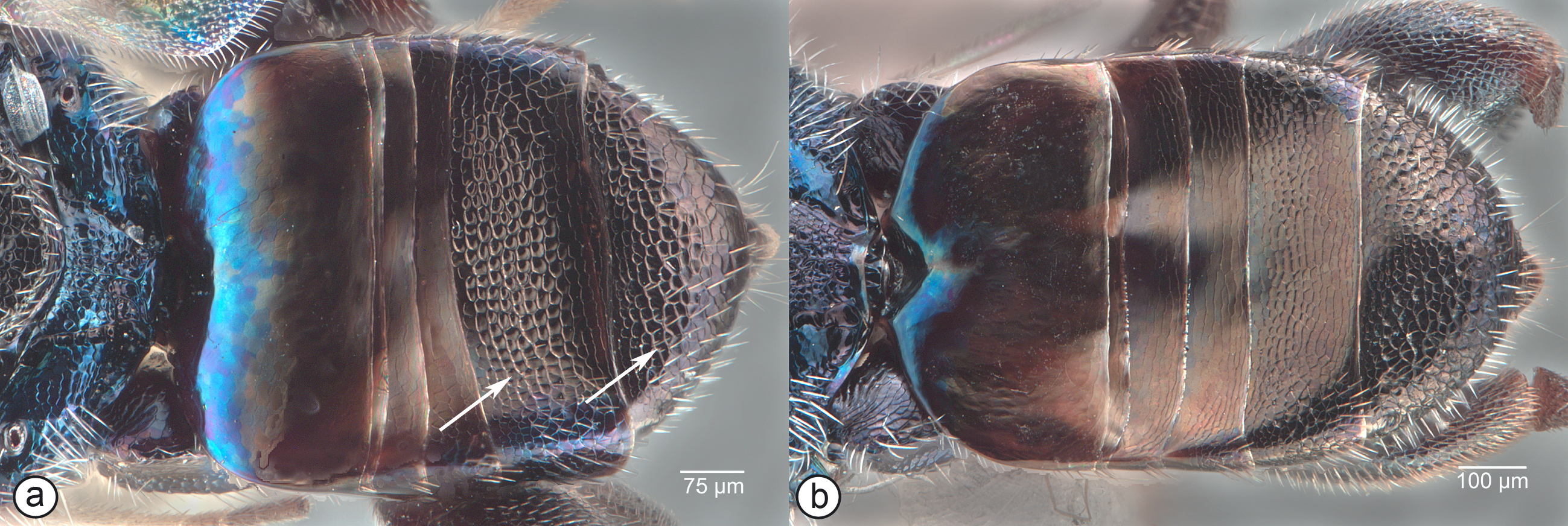 - Gaster with Gt6 and at least Gt5 basally comparatively coarsely reticulate to punctate-reticulate (a, b) …9 - Gaster with Gt6 and at least Gt5 basally comparatively coarsely reticulate to punctate-reticulate (a, b) …9
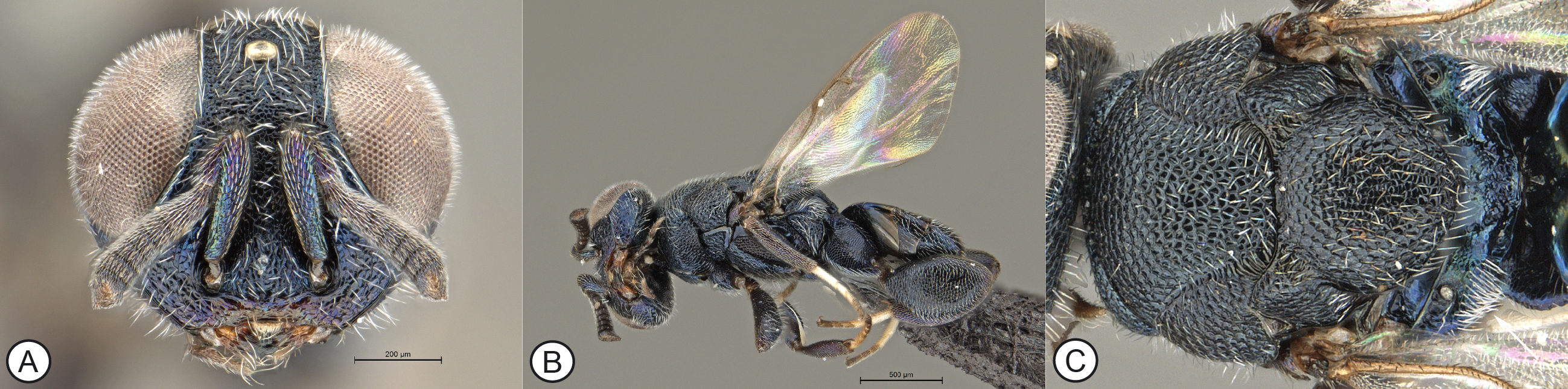 9(8) Head uniformly black or if dark bluish-black then at least without differentiated facial bands (A); interantennal region ꓥ-like in curvature, the sides dorsally convergent to obtusely angled midline and with elongate reticulate sculpture so as to appear mostly reticulate-imbricate, at most mesh like reticulate only narrowly along midline (Fig. 6A,B); fore wing with entirely dark setae (Fig. 7E) or if with variably extensive white setae basally and mesally these not extending along apical margin (B); mesoscutellum usually convex (B), appearing as long as or longer than wide with sides often entirely carinately margined and posteriorly convergent to variably distinctly angulate posterior margin (C) that in lateral view slightly overlaps metanotum (Fig. 6C,E), though sometimes flat and extending only to base of metanotum (Fig. 6D,F) similar to below; legs, excluding tarsi, entirely dark, including knees (B); labial and maxillary palps at least dark brown and not distinctively elongate (B); antenna dark (A) …Chalcedectus copelandi Gibson & van Noort, 2026. 9(8) Head uniformly black or if dark bluish-black then at least without differentiated facial bands (A); interantennal region ꓥ-like in curvature, the sides dorsally convergent to obtusely angled midline and with elongate reticulate sculpture so as to appear mostly reticulate-imbricate, at most mesh like reticulate only narrowly along midline (Fig. 6A,B); fore wing with entirely dark setae (Fig. 7E) or if with variably extensive white setae basally and mesally these not extending along apical margin (B); mesoscutellum usually convex (B), appearing as long as or longer than wide with sides often entirely carinately margined and posteriorly convergent to variably distinctly angulate posterior margin (C) that in lateral view slightly overlaps metanotum (Fig. 6C,E), though sometimes flat and extending only to base of metanotum (Fig. 6D,F) similar to below; legs, excluding tarsi, entirely dark, including knees (B); labial and maxillary palps at least dark brown and not distinctively elongate (B); antenna dark (A) …Chalcedectus copelandi Gibson & van Noort, 2026.
 - Head usually with quite distinct metallic green to blue lustre (a) and frontovertex often with variably conspicuous darker transverse band between eyes above scrobal depression even if head quite dark (a), and sometimes with similar sublateral darker bands extending dorsally from transverse band on either side of median ocellus (a); interantennal region comparatively flat such that sculpture mostly mesh like reticulate to reticulate-rugulose (a); fore wing sometimes with white setae along apical margin (b); mesoscutellum usually flat (b), appearing wider than long (c), with lateral margins carinately margined only basally (c) or within basal half, and posteriorly broadly rounded (Fig. 25A,F) and extending only to base of metanotum (Fig. 25A,C,E: no3), though sometimes similar to above (Fig. 25B,D) except never entirely carinately margined; legs sometimes with at least meso- and/or metafemora (b) narrowly pale apically and sometimes tibiae pale mesally (b); labial and maxillary palps often yellowish to brownish-yellow and distinctively elongate (b); antenna sometimes with some funiculars variably distinctly pale (a) …Chalcedectus tankwa van Noort & Mitroiu, 2026. - Head usually with quite distinct metallic green to blue lustre (a) and frontovertex often with variably conspicuous darker transverse band between eyes above scrobal depression even if head quite dark (a), and sometimes with similar sublateral darker bands extending dorsally from transverse band on either side of median ocellus (a); interantennal region comparatively flat such that sculpture mostly mesh like reticulate to reticulate-rugulose (a); fore wing sometimes with white setae along apical margin (b); mesoscutellum usually flat (b), appearing wider than long (c), with lateral margins carinately margined only basally (c) or within basal half, and posteriorly broadly rounded (Fig. 25A,F) and extending only to base of metanotum (Fig. 25A,C,E: no3), though sometimes similar to above (Fig. 25B,D) except never entirely carinately margined; legs sometimes with at least meso- and/or metafemora (b) narrowly pale apically and sometimes tibiae pale mesally (b); labial and maxillary palps often yellowish to brownish-yellow and distinctively elongate (b); antenna sometimes with some funiculars variably distinctly pale (a) …Chalcedectus tankwa van Noort & Mitroiu, 2026.
|